Technology
 PUBLISHED


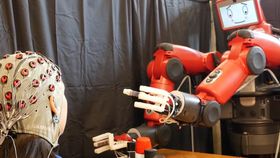


While most robots are quickly on their way to stealing all our jobs, "Baxter" is still our loyal pawn. MIT’s Computer Science and Artificial Intelligence Laboratory (CSAIL) and Boston University have been working to help develop mind-controlled robotics.
The job of Baxter is to carry out a simple object-sorting task while it’s being watched over by a human. The humanoid robot is able to decipher and process the brain waves within as little as 10 milliseconds, thanks to an electroencephalography (EEG) monitor attached to the human’s head. If the person notices the robot is making a mistake, the algorithms will pick up on this and the robot will correct itself in real-time.
“As you watch the robot, all you have to do is mentally agree or disagree with what it is doing,” CSAIL Director Daniela Rus said in a statement. “You don’t have to train yourself to think in a certain way – the machine adapts to you, and not the other way around.”
It’s a pretty cool party trick in itself, but the researchers believe this kind of technology could be developed to have some incredible day-to-day applications.
“Imagine being able to instantaneously tell a robot to do a certain action, without needing to type a command, push a button or even say a word,” Rus added. “A streamlined approach like that would improve our abilities to supervise factory robots, driverless cars, and other technologies we haven’t even invented yet.”
As long as humans are the ones doing the mind-control, it sounds good to us.