Technology
 PUBLISHED




After years in production, virtual reality(VR) headsets are now hitting the consumer shelves. But tech companies are already looking to the future, and developing the next step in VR. Haptic gloves for example, which will let users touch and feel objects that are not actually there, are already in progress.
But what about our other senses? Well, researchers have been developing ways to make it possible for us taste in VR.
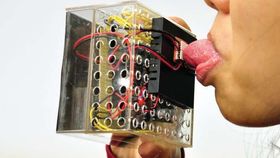
At least two teams have been working on ways to trick our brains into believing that not only are we tasting something that is not there, but also chewing something. Presented at the Annual Symposium on User Interface Software and Technology, researchers from the National University of Singapore showed how they were able to simulate the taste of sweet foods using a system that rapidly heats and cools the tongue.
“Being a pleasurable sensation, sweetness is recognized as the most preferred sensation among the five primary taste sensations,” write the researchers. “We present a novel method to virtually simulate the sensation of sweetness by applying thermal stimulation to the tip of the human tongue. Results from the preliminary experiments suggest that the participants were able to perceive mild sweetness on the tip of their tongue while using the proposed system.”
In the experiments, the participants have to touch their tongue to the thermoelectric elements, with around half of all tested detecting the sensation of sweetness. Others reported that when the element was hotter, they tasted spiciness, while when it was cooler it was more minty.
The researchers don’t necessarily have their eye on using it for conventional VR, however, but instead suggest that the devices could be fitted to glasses so trick people into thinking that low-sugar drinks are actually sweeter than they are.
But another group of researchers from the University of Tokyo is focusing on another aspect of eating and seeing if they can bring it to virtual reality, namely the texture of food. They have placed electrodes on the muscles in the jaw used for chewing, and by altering the frequency and length of an electric pulse, have been able to simulate levels of hardness and elasticity of virtual foods.
In experiments, they have tricked participants into thinking that real food they are physically chewing has a vastly different texture.
All of these developments, as mentioned before, are in the early stages of advancement, but could one day make a virtual world a much richer place to be.
[H/T New Scientist]



 1
1