


 Technology
 PUBLISHED


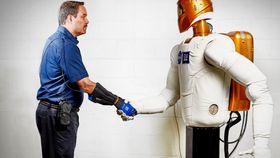


Although they were originally created with robots on the International Space Station (ISS) in mind, these “Robogloves” could soon be helping Earthlings in the realms of healthcare and manufacturing.
The gloves are the product of nine years of development between General Motors and NASA. The technology was originally designed for use for NASA's Robonaut 2, a robot that was launched into space in 2011. However, it's now being applied to soft wearable gloves.
The gloves feature a network of sensors, actuators, and “tendons”, which enable the wearer to grip tools with increased force, all while maintaining the normal dexterity of a human hand. It’s basically a soft exoskeleton for your hand.
In 2012, when the glove was still in development, NASA said you “might need to use 15 to 20 pounds of force to hold a tool during an operation. But with the robotic glove they might need to apply only 5 to 10 pounds of force.”
Kurt Wiese, vice president of General Motors Global Manufacturing Engineering, summarized in a news release: “The successor to RoboGlove can reduce the amount of force that a worker needs to exert when operating a tool for an extended time or with repetitive motions.”
It’s, therefore, ideal for assembly workers, manual laborers, and even surgeons. General Motors has just signed a licensing agreement with Bioservo Technologies AB, a Swedish medical technology company, although the applications for biomedicine are not clear just yet.

An up-close shot of the RoboGlove design. NASA/GM




 1
1