Technology
 PUBLISHED
 7
7
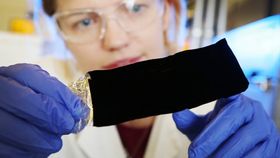


This new material is so black, scientists can't even measure it. In fact, it barely reflects any light at all.
This is a highly unusual property for most substances. Normally, when you shine a laser on a material, you can see the light from the laser drift across it as it reflects back at you.
This is how our eyes can see the colors that make up the world around us.
But when engineers from British company Surrey NanoSystems trace a laser over the blackest material ever, the light disappears
Surrey NanoSystems/YouTube. The new and improved Vantablack.
Where does the light go? Basically, it gets trapped inside the material.
Vantablack, as the material is called, is made by tightly packing carbon nanotubes — rods of carbon that are much, much thinner than any human hair — so close together that light goes in, but can't escape.
Surrey NanoSystems made the original Vantablack back in 2014, which they said absorbed 99.96% of the light that hit it.
But this new version of Vantablack (which we first heard about from ScienceAlert) is so black that their machines aren't powerful enough to measure its darkness.
Vantablack is mainly being used in research applications now, so you can't, say, buy a can of it to paint your walls with.
But that would be cool. Let us know if they ever start doing that.
Read the original article on Tech Insider. Follow us on Facebook and Twitter. Copyright 2016.
NOW WATCH: Scientists recorded something terrifying at the deepest part of the world's oceans