Space and Physics
 PUBLISHED


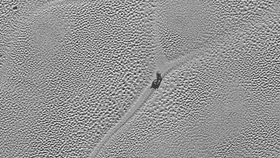


NASA’s New Horizons spacecraft has beamed down an image appearing to show a “snail trail” across Pluto’s icy wilderness.
The image from New Horizons' Long Range Reconnaissance Imager (LORRI) was taken on July 14, 2015, however the data only reached Earth on Christmas Eve 2015. The image shows Sputnik Planum, the 20-kilometer-wide (12-mile-wide) icy plain of Pluto.
Unfortunately, NASA doesn't think the blob is actually a snail. They say the black cosmic-gastropod is actually a “dirty” block of water ice being pulled through denser solid nitrogen by currents caused by density differences. The “X” junction is most likely to be “ridged margins,” according to NASA, which are raised by about 100 meters (328 feet).
“This part of Pluto is acting like a lava lamp, if you can imagine a lava lamp as wide as, and even deeper than, Hudson Bay,” William McKinnon, deputy lead of the New Horizons Geology, Geophysics and Imaging team, said on the NASA website.
You can check out the full-sized mosaic of Pluto’s icy plain images here.