Space and Physics
 PUBLISHED

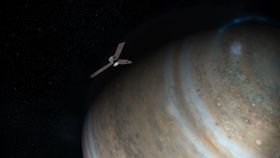


Get ready, because for the next year or so, you’re going to be hearing a lot more about Jupiter. Tomorrow, NASA’s Juno spacecraft will perform its first science flyby of the gas giant – and in the process, glimpse its poles like never before.
Juno entered orbit around Jupiter in July, the first spacecraft to do so since NASA’s Galileo in 1995. To keep itself safe from Jupiter’s radiation, though, Juno is in a wide sweeping orbit around the planet. At its furthest, it is up to 3 million kilometers (2 million miles) away. On Saturday, it will fly to just 4,200 kilometers (2,500 miles) above the clouds of Jupiter – its closest approach to the planet so far.
When Juno first entered orbit, its eight science instruments were turned off. This time around, all eight will be on, including JunoCam. This camera will snap high-resolution images of Jupiter and, for the first time, will get detailed images of Jupiter’s north and south poles. We have seen Jupiter’s polar region before, thanks to the Cassini spacecraft, but those views were somewhat obscured because Cassini viewed the pole from an angle.
"No other spacecraft has ever orbited Jupiter this closely, or over the poles in this fashion," said Steve Levin, Juno project scientist from NASA's Jet Propulsion Laboratory in Pasadena, California, in a statement. "This is our first opportunity and there are bound to be surprises. We need to take our time to make sure our conclusions are correct."
The flyby is expected to take place around 8.51am EDT (1.51pm BST) tomorrow, although imagery won’t be sent home straight away. A NASA spokesperson told IFLScience we could expect the first images to be released on Thursday, September 1.
This is the first of 36 flybys of Jupiter planned for Juno up until the end of its mission in February 2018, and it is just the beginning for some of the fascinating science we can expect from Jupiter.
"This is our first opportunity to really take a close-up look at the king of our solar system and begin to figure out how he works," Scott Bolton, principal investigator of Juno from the Southwest Research Institute in San Antonio, Texas, said in the statement.