Space and Physics
 PUBLISHED


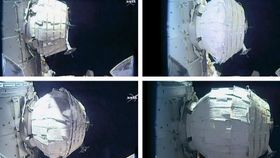


After a failed attempt on Thursday, NASA’s first expandable habitat on the International Space Station (ISS) finally ballooned up to its full size on Saturday.
It took over seven hours for astronaut Jeff Williams to totally inflate the Bigelow Expandable Activity Module (BEAM) with air, along with the help of a team from NASA and Bigelow Aerospace working back home at Mission Control Center at NASA’s Johnson Space Center. You can watch sped-up footage of this process in the video below.
During the pressurization of BEAM with the rest of the ISS, Williams said he heard popping noises that he compared to popcorn in a frying pan, according to the Associated Press. Officials said that these sounds were likely the internal straps releasing as the chamber inflated.
Over the coming weeks, the team will conduct tests to ensure the structural integrity of BEAM. With a bit of luck, Williams will make his first entrance into the module the following week. The “space-balloon,” which is now around 4 meters (13 feet) long and about 3.2 meters (10.5 feet) in diameter, will remain on the ISS for a two-year test period.
Expanding modules are designed to save room, which is a precious commodity in space travel. The use of this technology comes as an important breakthrough, as these are the types of habitats that could make future missions – such as manned missions to Mars – a little bit easier.