Ad

space-iconSpace and Physics
clock-iconPUBLISHEDAugust 22, 2017
comments icon3

The Most Gorgeous Images Of The 2017 Total Solar Eclipse

Tom Hale headshot

Tom Hale

Tom has a Master's degree in Journalism. His editorial work covers anything from archaeology and the environment to technology and culture.

Senior Journalist

Tom has a Master's degree in Journalism. His editorial work covers anything from archaeology and the environment to technology and culture.View full profile

Tom has a Master's degree in Journalism. His editorial work covers anything from archaeology and the environment to technology and culture.

View full profile
article image

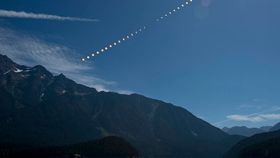
This composite image shows the progression of the partial solar eclipse over Ross Lake, in Northern Cascades National Park, Washington on August 21, 2017. NASA/Bill Ingalls


Yesterday, millions of Americans gathered around for the total solar eclipse skimming across the US from coast to coast, while millions more from around the globe jealously watched on through Internet live-streams and TV broadcasts.   

The rest of this article is behind a paywall. Please sign in or subscribe to access the full content.

Although there’s no doubt that seeing it with your own eyes is best, the phenomenon brought us some incredible images to enjoy, from social media snappers enjoying the solar eclipse in a park to scientific imagery from the most cutting-edge imaging equipment available, and even a few snaps from the six astronauts onboard the International Space Station. 

It's over for now but take a moment to wonder over some of the most gorgeous and scientifically significant imagery to come out of this incredible celestial display.

See you all again on July 2, 2019 in South America for the world's next total solar eclipse.  

Just six humans - NASA’s Randy Bresnik, Jack Fischer and Peggy Whitson, ESA's Paolo Nespoli, and Roscosmos’ Commander Fyodor Yurchikhin and Sergey Ryazanskiy - witnessed the solar eclipse's umbra from space. ISS/NASA 
The Moon's "shadow" cast on the US, as seen at an altitude of around 250 miles high. ISS/NASA 
People watch the solar eclipse at Saluki Stadium on the campus of Southern Illinois University on August 21 in Carbondale, Illinois. Although much of it was covered by a cloud, with approximately 2 minutes 40 seconds of totality, the area in Southern Illinois experienced the longest duration of totality during the eclipse. Scott Olson/Getty Images
A total solar eclipse is seen on Monday, August 21, 2017 from onboard a NASA Armstrong Flight Research Center’s Gulfstream III 25,000 feet above the Oregon coast. NASA/Carla Thomas
Composite image made from four frames, showing the International Space Station, with a crew of six onboard, as it transits the Sun at roughly five miles per second during a partial solar eclipse, August 21, 2017. NASA/Joel Kowsky
The Wink: The solar eclipse, as seen from Apopka, Florida. Scott Smith/Flickr (CC BY-NC-ND 2.0)
This composite image shows the progression of the total solar eclipse over Madras, Oregon on August 21, 2017. NASA/Aubrey Gemignani
Image of the Moon transiting across the Sun, taken by SDO in 171 angstrom extreme ultraviolet light.  NASA/SDO
The solar eclipse is seen behind the Statue of Liberty at Liberty Island in on August 21, 2017 in New York City. While New York was not in the path of totality for the solar eclipse, around 72 percent of the Sun was covered by the Moon during the peak time of the partial eclipse. Photo by Noam Galai/WireImage/Getty Images
The Diamond Ring effect, or Bailey's beads, is seen as the Moon makes its final move over the sun during the total solar eclipse. NASA/Aubrey Gemignani

Written by 

Add us as a Google preferred source to see more of our
trusted coverage in Search