Space and Physics
 PUBLISHED


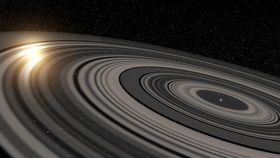


In 2015, astronomers discovered a planet with a ring system more than a hundred times larger than Saturn’s rings. Such a gigantic system could be destroyed very quickly, so scientists looked into what could make it stable. They discovered that the rings must rotate in the opposite direction compared to the planet’s rotation around its star, called J1407.
Steven Rieder from the RIKEN institute in Japan and Matthew Kenworthy from Leiden University have simulated several scenarios to explain the peculiar world. The team discovered that the most likely explanation for what’s observed is a planet between 60 to 100 times the mass of Jupiter with a large retrograde rotating ring.
The data suggest that the planet is on a very eccentric orbit, going from very close to the star to very far every 11 years. The gravity of the star at the closest approach is enough to rip the ring apart but as long as they are spinning the other way, they are stable for more than 100,000 years.
"It might be far-fetched: massive rings that rotate in opposite direction, but we now have calculated that a 'normal' ring system cannot survive,” said lead author Rieder in a statement.
"The system is only stable when the rings rotate opposite to how the planet orbits the star."
This set up is very rare. Rings and satellites tend to rotate in agreement with their orbital motion so, in the paper available online and soon to be published in Astronomy & Astrophysics, the researchers suggest a cataclysmic event caused either the ring or the planet to start rotating in the opposite way.
Alternative scenarios were also investigated to explain the complex series of eclipses the star underwent in 2007. They toyed with the idea of free-floating objects obscuring the star for 56 days, but it seemed a very unlikely explanation.
“The chance of that is minimal," continued Rieder. "Also, the velocity measured with previous observations may not be right, but that would be very strange because those measurements are very accurate."
The team hopes to further study the system and find out how such an intriguing star system might have formed.