Space and Physics
 PUBLISHED




The end is not really the end, at least if you’re a star. When their life comes to an end, stars simply change into something else. Supernovae, black holes, and white dwarfs are all well known final stages of stars, but the universe can still surprise us.
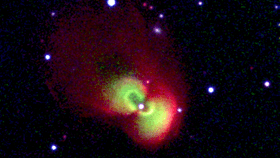
The rest of this article is behind a paywall. Please sign in or subscribe to access the full content.Astronomers using the South African Large Telescope (SALT) were able to observe a rare pulsating white dwarf. The unusual object, called Te 11, is the result of a stellar explosion that happened 1,500 years ago, and it has been going through periodic "hiccups" after stealing material off its companion star. Such an object is called a dwarf nova.
"Pairings in astronomy as found in Te 11 are exceedingly rare, but it is anticipated that planned studies of the night sky will find a whole lot more," said Professor Patrick Woudt, head of astronomy at the University of Cape Town and co-author of the study, in a statement.
Te 11 is located about 1,070 light-years away in the constellation of Orion. It is a binary system made of a white dwarf 1.2 times more massive than our Sun, and a larger but lighter companion orbiting about twice the Earth-Moon distance. A paper highlighting the findings was published in Monthly Notices of the Royal Astronomical Society.
The connection between Te 11 and the nova explosion 1,500 years ago was possible thanks to precise archives from Chinese astronomy. According to historical records, a new star (nova) appeared in 483 CE near the position of Te 11, making it for a short time brighter than any other star in the night sky.
Astronomer thinks these objects are not as rare as we think, and they plan to use a wide-field study of the southern sky in optical and radio waves, such as MeerLICHT and MeerKAT, to find more.
"Planned surveys with MeerKAT and MeerLICHT will scan the southern skies for more of these unusual objects, which can tell us more about the formation and the evolution of these compact binaries in the Milky Way," said Woudt.