


 Space and Physics
 PUBLISHED


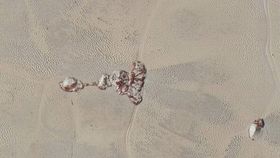


Since New Horizon’s flyby last July, Pluto has been a trove of unique geology and bizarre phenomena. Astronomers have tried to understand the most puzzling ones, and they might already have an explanation for the hills within the "heart" of Pluto.
Sputnik Planum, the flat region of Pluto’s heart-shaped area, is freckled with water ice hills that stretch across the plane in long chains and groups, as well as some isolated objects. The New Horizons team thinks these hills are similar to Earth’s icebergs, moving across the plane and slowly being pushed around by the still-mysterious convection happening within the dwarf planet.
The region is made mostly of nitrogen ice, which is significantly denser than water ice, so the hills actually "float" on the surface. They are probably fragments of the large water ice formations found in the Tombaugh Regio region, which look like blocky mountains.

When the hills break off from the large glaciers, they drift along into the frozen nitrogen sea and enter the cellular terrain. They are pushed to the edge of these cells by the convection motion that formed them. The hill chains are quite large, reaching up to 20 kilometers (12 miles) across.
The largest cluster of ice hills is north of the hill chains and is informally called Challenger Colles, in honor of the lost crew of the space shuttle Challenger. The cluster measures 60 by 35 kilometers (37 by 22 miles). Astronomers think that the unusual size is due to the fact that nitrogen ice is particularly shallow in the region.
Sputnik Planum is believed to have formed when a large impactor hit the surface of Pluto. The area was then filled with ice volatiles, a mixture of water ice, nitrogen, and ammonia. Heat from the planet core has kept the convection going and the region geologically young.




 1
1