


 Space and Physics
 PUBLISHED


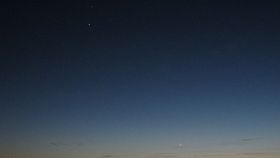


If you can drag yourself from your bed half an hour before dawn on Monday morning you should be in for a treat (weather permitting). Jupiter and Venus will be at their closest for 14 years, making a truly magnificent sight.
Conjunctions of planets (when they appear to approach each other in the sky) come along quite often, but as the two brightest astronomical objects after the Sun and Moon, close encounters of Venus and Jupiter are special.
Not all of such events are equal however. On some occasions the two planets never get closer than 6° – about half the width of a fist if you hold your hand at full stretch. On other occasions the pair might appear close in the sky, but are overwhelmed by the sun. Since Venus never gets more than 48° from the sun in the sky, this happens much more frequently than for approaches of planets further out from us such as Jupiter and Mars.
This time however, the two planets will be just 0.2° apart at their closest, line of sight disguising the fact that their true distance is actually more than 700 million kilometers. However, where some conjunctions provide multiple opportunities to see two planets close to each other, this one is an exception. From our perspective the two are moving in opposite directions, so if you miss them on Monday they'll separate very fast thereafter.
With the naked eye the two will look so close and bright that an outbreak of UFO reports is anticipated. However, for a real feast for the eyes binoculars or a small telescope are recommended.
The close approach will take place against a backdrop of M44, also known as the Beehive Cluster, one of the most famous open clusters in the sky and a treat with binoculars on its own. At the moment the Beehive is so close to the sun that the stars won't be at their brightest, but with the planetary pair at their edge the effect should be breathtaking.
Two Micron All Sky Survey. Jupiter and Venus will appear just outside the open cluster known as the Beehive Nebula, pictured.
A home telescope on low magnification will show both planets in the same field of view, along with Jupiter's Moons.
Clouds aside, a close conjunction will be visible throughout the world, other than Antarctica, but only those in Europe or Africa will get to see them at their very closest.
Skymap. How the pair will appear relative to M44 in binoculars
A good view east is required, as the pair will only be about 10° above the horizon as the sky starts to lighten. The will appear almost directly below Castor and Pollux, and roughly in line with Procyon.


