Space and Physics
 PUBLISHED


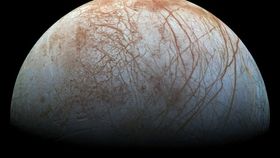


If you were to ask a betting astronomer where we will find life in the Solar System, they would almost certainly put their money on Europa, the icy satellite of Jupiter. And according to the latest study, the odds are very much in their favor.
Researchers from NASA's Jet Propulsion Laboratory (JPL) in Pasadena, California have looked at the potential chemistry of Europa’s subsurface ocean, and they found that the Jovian moon's production of oxygen and hydrogen is comparable to Earth’s, with oxygen production being 10 times higher than hydrogen production.
Hydrogen would form by reactions on the seafloor between the salt water and the rock. The bottom of the ocean is likely cracked, and as the water penetrates the rocks, it dissolves minerals and releases positive hydrogen ions.
Oxygen, and other products that can react with hydrogen, form on the surface from the radiation emitted by Jupiter that breaks apart the water-ice molecules, creating negative ions underneath Europa’s icy exterior.
“The oxidants from the ice are like the positive terminal of a battery, and the chemicals from the seafloor, called reductants, are like the negative terminal,” said Kevin Hand, co-author of the study, in a statement.
“Whether or not life and biological processes complete the circuit is part of what motivates our exploration of Europa.”
The study, published in Geophysical Research Letters, shows another interesting fact: Europa doesn’t require volcanism to be a habitable environment. Cold rocks fracture more easily so that more hydrogen is produced. If instead the interior of the planet is hot, minerals from hydrothermal vents interact with the oxidants from the surface. In either scenario the ocean could be habitable.
“We’re studying an alien ocean using methods developed to understand the movement of energy and nutrients in Earth’s own systems,” added lead author Steve Vance. “The cycling of oxygen and hydrogen in Europa’s ocean will be a major driver for Europa’s ocean chemistry and any life there, just as it is on Earth.”
NASA is currently formulating proposals for missions to Europa, so the truth about this curious moon might come sooner than we think.