Space and Physics
 PUBLISHED

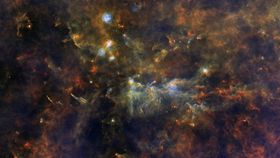


Say hello to the little fox and the giant stars.
In this newly developed image by NASA and the European Space Agency, taken by the latter’s Herschel space observatory across five different wavelengths, a star-forming region within the constellation of Vulpecula (Latin for “little fox”) – located 8,000 light-years away from Earth – is dramatically revealed.
This particular region, known as Vulpecula OB1, is a "stellar association," a section of deep space that gives birth to the most massive stars known to humanity – types “O” and “B”. True to form, some of the giant stars in this image are the most massive in the galaxy; as big stars tend to do, these will burn out quickly and have short, violent lives.
Some of these nuclear forges are estimated to be around 2 million years old, meaning that they are already nearing the end of their lifespans and are due to turn into cataclysmic supernovae sometime in the near future, astronomically speaking.
The O stars are anywhere from 16 to 100 times more massive than our own Sun, and up to 1 million times brighter to boot. B stars, on the other hand, are only between 2 and 16 times as massive as the Sun, and up to 30,000 times brighter. Only those that have a mass equivalent to eight Suns or more will undergo a runaway self-destructive collapse leading to a supernova; those under that will swell before shaking off their outer layers, forming a planetary nebula.
In either case, much of that leftover material, those nuclear ashes viewable in this beautiful image, will eventually begin to collapse and form the basis of new stars – and thus, the celestial cycle of death and rebirth continues.