Space and Physics
 PUBLISHED


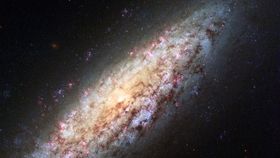


Most galaxies are bunched together in clusters or groups, which makes an exception particularly interesting. Taken by the Hubble Space Telescope, the magnificent image above is of NGC 6503, a galaxy that sits on its own at the edge of a region known as the Local Void.
NGC 6503 is 18 million light-years away. While this is a mind-bending distance by our daily standards, it's exceptionally close on a cosmic scale. In fact, it is one of the closest galaxies that is not part of the Local Group. Nor is it some small, trumped-up globular cluster expelled from its home. At 30,000 light-years across, it is a third of the size of our home galaxy, but much larger than most of the galaxies closer to us.
The Local Void is an area 150 million light-years across with no galaxies within it—a huge, puzzlingly empty space by the standards of the nearby universe. Hubble has shown that the Milky Way is affected by the Local Void. Just as large concentrations of galaxies, such as the Great Attractor, exert gravitational attraction on galaxies over a vast distance, the absence of galaxies in one direction when there are pulls in every other has an effect equivalent to being pushed away by the gap.
This effect makes NGC 6503's presence on the edge of the void even more interesting, as it too should be drawn away. Dubbed the “Lost-In-Space galaxy” by Stephen James O'Meara in a book on little known beauties for amateur astronomers, NGC 6503 was included in an intensive study of what UV light reveals about the structure of nearby galaxies.
The paper concluded that NGC 6503 has a “starved black hole” at its core, one that is largely deprived of gas to keep it active. The study also included videos that show both NGC 6053's place in space, and its beauty in great detail. You can watch them both below.
Credit: NASA & ESA
Credit: NASA & ESA

 2
2