Nature
 PUBLISHED




The discovery of the oldest known deliberately buried fish-hooks challenges common perceptions of gender roles among hunter-gatherers. The hooks were found buried with a skeleton on the Indonesian island of Alor, almost certainly in the expectation they would be needed in the afterlife. The skeleton appears to belong to a woman, and the fish-hooks are of a design predominantly used for deep-sea fishing, findings that may be more surprising to the general public than anthropologists.
The rest of this article is behind a paywall. Please sign in or subscribe to access the full content.Humans have been fishing for a long time, but initially used hands or spears. The oldest fish-hook known dates to 20-23,000 years ago in Japan. However, this appears to have been dropped randomly and doesn't offer the wealth of information that comes with deliberately buried items, also known as grave goods.
Our ancestors may have been using hooks long before, but rising sea levels have drowned most of the sites where coastal populations thrived. To get around this problem, Professor Susan O'Connor of the Australian National University turned to Alor. She told IFLScience the site was chosen because the seafloor drops away very sharply close to shore, and the island is experiencing geological uplift. Consequently, the shoreline is very close to where it was during the last Ice Age, making burial sites accessible.
Alor is also a particularly interesting location. Just north of Timor, it is part of the area known as Wallacea, a collection of mostly volcanic islands that have never been connected by land to either the Asian or Australian mainlands. Consequently, there were almost no large land animals before human farmers introduced them. The first inhabitants depended on the sea for animal protein. O'Connor said 96.8 percent of the animal bones found at Alor campsites were from fish.
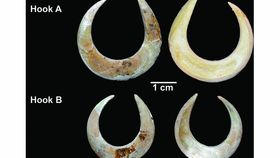
Unsurprisingly, the islanders excelled at fishing, and presumably valued their tools highly. O'Connor told IFLScience that grave goods were rare in the region before the beginnings of agriculture. Consequently, only very high-status individuals would be buried with five hooks and a shell scraper, yet this is what O'Connor found in a 12,000-year-old grave. Although only the skull has been recovered, O'Connor and fellow authors of a paper in Antiquity are confident it belonged to a woman.
Fish-hooks the world over come in two styles, J-shaped and circular rotating. The latter is preferred for deep-water fishing, where lines cannot be kept taut. Similarly shaped devices have been found throughout the Pacific. Both sorts were discovered with the Alor skeleton, suggesting those who buried her expected her to fish partly in deep waters in the afterlife.
Anthropologists are aware that among Australian Aborigines, women fished with hook and line, while men used spears, but this is frequently ignored in popular portrayals of gender roles in pre-agricultural societies.