Nature
 PUBLISHED


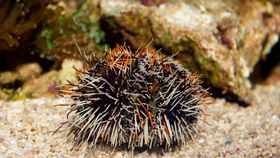


To add to a week of creature discovery that equates to the stuff of nightmares, meet the innocuous-looking sea urchin with the most surprising (and terrifying) defensive weapon. When under attack, it releases hundreds of still-biting “heads” with “jaws” that attach to their attacker, delivering tiny venomous bites.
This “waterborne pursuit-deterrent signal”, as the researchers describe it, was discovered by marine biologist Hannah Sheppard-Brennand and her team from Southern Cross University, Australia. It’s not unusual for animals to have projectile defenses, however the discovery that Tripneustes gratilla releases biting heads that seem to be capable of independent action is definitely unique.
“The globiferous pedicellariae [heads] are minute and terrifying,” Sheppard-Brennand admitted to New Scientist. “When they were first observed, they were thought to be parasites, as they give the appearance of independent action from the main animal.”
Pedicellariae heads are commonly found in echinoderms. The little pincer-like heads are attached to a movable stalk and are used for attracting food as well as fending off predators. They usually remain attached to the urchins, though. Published in The American Naturalist, the new study describes how T. gratilla’s pedicellaria heads actually detach from the body in a defensive cloud, seek out the attacker, latch on, and carry on biting, releasing their venom.
The researchers tested this in both field and lab conditions and found the same result. They simulated fish attacks in the lab by gently poking the urchins and they usually responded by releasing tens of the little biters. Sheppard-Brennand explained that it takes between 40 and 50 days for the pedicellariae to regenerate, but because they have so many of them, they only need to release a small amount. However, they witnessed an individual producing hundreds in just 30 seconds, too.
The researchers conclude that this unusual defense mechanism could help explain how sea urchins can reach such high densities on reefs. Basically, they terrify the bejeezus out of anything that dares approach.