Nature
 PUBLISHED


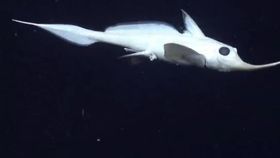


Deep ocean inhabitants are not known for their beauty. Rather they usually dominate lists of the ugliest creatures on the planet. However, an exception has emerged in the form of the smallspine spookfish (Harriotta haeckeli).
Very little is known about this particular spookfish, although the brownsnout spookfish has attracted attention for its unusual vision.
The rare footage of the shark relative, a member of the Rhinochimaeridae family, was taken last year in Hydrographer Canyon in the North Atlantic. The video was taken by the National Oceanic and Atmospheric Administration's ROV Deep Discoverer, launched from the Okeanos Explorer, which conducted a voyage to explore deep-sea canyons off America's east coast.
H. haeckeli have been found in the open seas near Greenland to New Zealand, but live at such depths (below 2,600 m) they are hardly ever seen. The International Union for the Conservation of Nature considers data on them insufficient to classify their status, but there are fears they may be threatened by deep-sea trawling.
The species is not known to grow beyond 70 centimeters in length, but has a venomous spine for defense. The claspers suggest the individual in the footage is a male.