Nature
 PUBLISHED

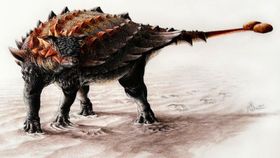


A new armored, club-tailed dinosaur has been discovered in Upper Cretaceous deposits in the American Southwest. The spiky new species is named Ziapelta sanjuanensis, and it’s closest relatives likely lived way up north, in Alberta, Canada. The findings were reported in PLoS One this week.
Ankylosaurs -- which includes the heavily armored Ankylosaurus, with its massive bony club of a tail -- lived from around 76 million to 66 million years ago. Few have been discovered in the southern parts of the North American continent, and at least five species are known to have lived in Alberta. At the time, an inland sea split the continent into two, and residents of Alberta and New Mexico enjoyed coastal living. (Meanwhile, most of Nebraska was under water.) And while ankylosaur fossils are common in several rocky formations in southern Alberta, none have been found in the lower part of an area called the Horseshoe Canyon Formation. Turns out, the rocks in New Mexico fill this gap in Alberta’s ankylosaur fossil record.
Back in 2011, researchers from New Mexico Museum of Natural History and Science unearthed a complete skull, incomplete first and second cervical half rings (the yokes of bone sitting over the neck, pictured below), and several other fragments from the De-na-zin Member of the Kirtland Formation at Hunter Wash, San Juan Basin, in northwestern New Mexico.

Based on the distinct skull and the unusually tall spikes of the cervical half ring, a team led by Victoria Arbour from the University of Alberta determined it was a new ankylosaur species. “The horns on the back of the skull are thick and curve downwards, and the snout has a mixture of flat and bumpy scales -- an unusual feature for an ankylosaurid,” Arbour explains in a news release. “There's also a distinctive large triangular scale on the snout, where many other ankylosaurids have a hexagonal scale.”
The genus name, Ziapelta, comes from the Zia sun symbol (a stylized sun with four sets of rays), which has religious significance to the Zia people of New Mexico and serves as the symbol on the state flag. And “pelta” is Latin for “small shield,” in reference to the bony, plate-like deposits (called osteoderms) found on all ankylosaurids. The species name refers to San Juan County and the basin where the specimen came from.
 The team’s analyses also suggest that Ziapelta is not closely related to the other ankylosaur from the De-na-zin Member, called Nodocephalosaurus kirtlandensis. Rather, the new dino allies with the northern North American ankylosaurids, including Ankylosaurus and four others. It’s possible that Ziapelta also lived in Alberta, likely in the gap where researchers haven't found any ankylosaur fossils yet.
Images: Sydney Mohr (top), 2014 Arbour et al., PLoS ONE (middle), University of Alberta (bottom)