Nature
 PUBLISHED




Researchers have discovered that when capuchin monkeys smash rocks together, they accidentally produce flakes that are identical to some of the rudimentary tools created by early hominins. This finding could redefine our understanding of human evolution by providing clues as to the roots of stone tool technologies.
Reporting their discovery in the journal Nature, the study authors explain that no living primate can be used to directly study the behavior or cognition of extinct hominins. This being the case, we have no choice but to try and extrapolate from the archaeological records relating to these ancient species. The appearance of stone tools in these records has always been regarded as evidence of advancements in hominin intelligence.
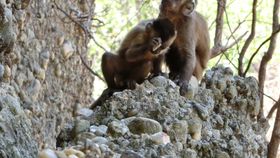
However, when observing bearded capuchin monkeys in Brazil’s Serra da Capivara National Park, researchers found that these primates regularly break stones against one another for a range of different purposes. As a by-product of this smashing process, the monkeys often produce “recurrent, conchoidally fractured, sharp-edged flakes and cores that have the characteristics and morphology of intentionally produced hominin tools.”
Though the monkeys discard these flakes and don’t use them for cutting or scraping as early hominins would have done with their tools, study co-author Tomos Proffitt told IFLScience that “the capuchin material gives us an interesting insight into how stone tool technologies might have emerged prior to the earliest archaeological records.”
He added: “It shows us that maybe the very fundamental criteria that we use to define a uniquely human or a uniquely hominin technology isn’t necessarily now a priori associated with hominins. It’s now uniquely primate.”

Examples of stone flakes made by capuchin monkeys. Proffitt et al / Nature
Fascinatingly, the monkeys’ accidental flakes were found to meet all of the criteria used to identify intentional stone flakes at archaeological sites. Central to this is the presence of a type of cut known as a conchoidal fracture, which Proffitt describes as “the basis of all stone technology”, and as such provides one of the main characteristics that archaeologists look for when attempting to determine if a flake has been deliberately made.
The fact that capuchins are able to accidentally produce this fracture indicates that the level of intelligence and hand complexity required in order to create a flake may be lower than previously thought. This, in turn, raises new questions regarding when the jump from making accidental flakes to deliberate tools might have occurred.
In spite of this, Proffitt insists there is no reason to believe that any hominin tools discovered up to now were actually just accidental monkey flakes, since “the level of complexity in hominin sites is much higher – you have cut marks, bones, and hominin remains. The hominins are using the flakes, which is something you never see with the monkeys, ever.”