Nature
 PUBLISHED


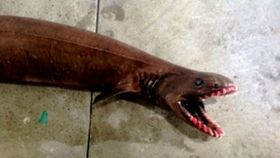


For the first time in local memory, this deep-dwelling shark has been captured in waters off Victoria, Australia. And with a face like that, it's a fairly safe bet that a fisherman would have remembered catching one.
“We couldn't find a fisherman who had ever seen one before,” said Simon Boag of the South East Trawl Fishing Association (SETFIA).
Despite looking more like an eel, particularly one from the pages of fantasy, the specimen is actually a Chlamydoselachus anguineus, or frilled shark. Although not a surface dweller, they live as shallow as 50 meters (164 feet), and on one occasion, was even filmed almost a kilometer (0.6 miles) down. Their preference for deep water means they are seldom captured alive, but have nevertheless been suggested as a possible source for sea serpent myths.
The sharks grow to almost 2 meters (6.5 feet) long and are occasionally caught as bycatch on the continental slopes of the Pacific and Atlantic. It is classified as Near Threatened. This specimen was caught at 700 meters (2,297 feet), the maximum depth at which trawling is allowed in most Australian waters in the area.
Credit SETFIA: The shark was 1.6 meters long
"It does look 80 million years old,” says Boag. “It looks prehistoric.” And he's not alone. The first taxonomists to encounter these creatures thought they were related to an extinct order, such as the hybodontiformes. Even today the frilled shark is suspected to be one of the most ancient species of sharks still surviving, dating back at least 95 million years.
But if all of that is making you forget just how scary these things can be, just remember, “It has 300 teeth over 25 rows,” Boag told ABC. “So once you're in that mouth, you're not coming out.”
Credit: SETFIA: It is thought the sharks use their flexible necks to grab prey and vicious teeth to hold them.