Nature
 PUBLISHED


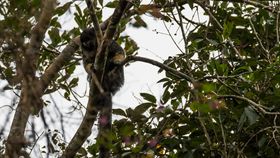


Biologists have managed to take the first ever photographs of a rare monkey not seen for over half a century. Only known from a handful of skins in a smattering of museums, the Vanzolini’s bald-faced saki monkey is so rare and elusive, no scientist had set eyes upon the primate in the wild for at least 80 years.
The monkey was found in a remote region of the western Amazon during the expedition Houseboat Amazon led by Dr Laura Marsh, exploring the Upper Juruá watershed in the Brazilian states of Acre and Amazonas. With finding the rare primate as their primary goal, the team succeeded within just a few days of their three-month-long project, observing the monkey for the first time in 81 years, and taking the first ever photographs of the critter.
Over the next few months, they documented the large-bodied black and blonde monkey sporting a wonderfully retro bowl-cut. Armed with the knowledge, and more importantly, the evidence, that the monkey was still alive and seemingly well in the region the researchers now want local officials to do more to protect the secretive primate.

The monkey was first identified in 1936 by Ecuadorian naturalist Alfonzo Olalla during an expedition to the upper Juruá River, where he collected a number of live specimens of the animal. These skins were then sent to a museum, where they were classified as belonging to the same species of another type of saki monkey. It was not until in 2014 that Dr Marsh noticed that these original skins had distinctive enough markings that the creature should be elevated to its own species: the Vanzolini’s bald-faced saki.

The last time anyone is thought to have seen the monkey was in 1956, when an ornithologist and taxidermist traveled to the region and came back with two dead animals, although they probably never saw it alive. Since then, for more than 60 years, there have been no reports of the rare primate in the wild, and still no photographs, until a report earlier this year of one caught by a hunter.
Now Dr Marsh and her colleagues have finally confirmed what she believed to always be the case, it's still out there in the Amazon. Unfortunately, as is often the case, things might not be so rosy for Vanzolini’s bald-faced saki, and the wealth of biodiversity that shares its rainforest. Hunting threatens the primate, and deforestation and road building threatens to further usher in their decline. It is now hoped that more can be done to safeguard the peculiar-looking monkey for the future.
[H/T: Mongabay]