Nature
 PUBLISHED


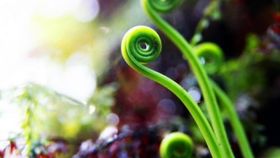


Ferns may look wholesome but they've been caught getting frisky with relatives of moss, picking up DNA vital to their modern success in the process.
Forest-floor dwelling ferns use a protein called neochrome to chase the limited light available. Where they developed the gene for neochrome has been an intriguing puzzle with several improbable answers. But the latest explanation is more surprising than any of them.
Neochrome is “chimeric gene”, fusing blue and red light sensing proteins. It was a puzzle because a green algae species has it too, suggesting the gene might be very ancient but strangely lost to other species or evolved independently. An alternative explanation is horizontal gene transfer (HGT) from one species to another.
Now a paper in Proceedings of the National Academy of Sciences concludes the algae neochrome was a red herring, with differences from the fern DNA . Hornworts, humble relatives of moss, evolved neochrome independently from the algae. Ferns and hornworts having been evolving independently for around 400 million years, but Fay-Wei Li, a PhD student at Duke University, and colleagues from a host of other institutions found ferns gained neochrome 180 million years ago. This explains why the most primitive ferns don't have it, and those that do, including Cytheales and Polypodiales flourished on the floors of Cretaceous forests when broadleaved plants appeared.
The authors note, “Despite being one of the oldest groups of land plants, the majority of living ferns resulted from a relatively recent diversification following the rise of angiosperms. To exploit fully the new habitats created by angiosperm-dominated ecosystems, ferns had to evolve novel adaptive strategies to cope with the low-light conditions exerted by the angiosperm canopy. Neochrome, an unconventional photoreceptor that allows ferns to “see the light” better, was likely part of the solution.”
Furthermore, while HGT is not as common in plants as bacteria, who trade genes like Pokemon cards, evidence is emerging it is more common than we previously realized. Adding to this is the discovery that the neochromes in ferns have a far more jumbled and complex relationship than the species of ferns in which the genes sit (see image below). Neochrome genes have been flitting between fern species like bees between flowers.Some genes are just a whole lot more promiscuous than others, and it seems neochrome may be rich in the transposons (or jumping genes) that facilitate species swapping. On top of this ferns are almost unique in that their gametophyte, or sperm and egg producing organs, can live independently. During this stage the gametophytes “have no protective layer on top, no cuticle," says Duke's Professor Kathleen Pryer. Perfect conditions to share a few genes, particularly in the moist environments ferns favor.
Li notes ferns are the only lineage of land plants that lack a reference genome and is working to correct this, which he hopes will reveal if HGT is common for other genes as well.
HT Scientific American, for much more detailed coverage of this story.