Ad

space-iconSpace and Physics
clock-iconPUBLISHEDMay 21, 2014

Supercooled Helium Does Things That Don't Seem Possible

Stephen Luntz headshot

Stephen Luntz

Stephen has degrees in science (Physics major) and arts (English Literature and the History and Philosophy of Science), as well as a Graduate Diploma in Science Communication.

Freelance Writer

Stephen has degrees in science (Physics major) and arts (English Literature and the History and Philosophy of Science), as well as a Graduate Diploma in Science Communication.View full profile

Stephen has degrees in science (Physics major) and arts (English Literature and the History and Philosophy of Science), as well as a Graduate Diploma in Science Communication.

View full profile
article image
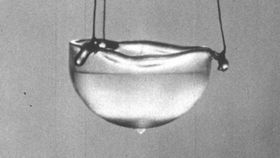
AlfredLeitner. A thin film of liquid helium creeps up the side of the container, over the edge and forms a droplet on the bottom before dropping below until the container is empty.

We all know helium as a gas for blowing up balloons and making people talk like chipmunks. It's also incredibly important as a coolant for medical devices and scientific instrumentation. However, what is less known is that helium has two different liquid states, one of which is truly strange, bordering on creepy.
The rest of this article is behind a paywall. Please sign in or subscribe to access the full content.
 
Helium I occurs between 2.18 and 4.22 Kelvin (that is -270.97°C to -268.93°C ). It has a few quirks of its own. For one thing it is almost impossible to see, so that scientists float things in it just to be able to work out where the surface is. This is a result of being both transparent and barely slowing light at all compared to a vacuum, or the Earth's atmosphere.
 
However, it is when we go below 2.18K that things get really weird. This BBC video will give you some idea:


Written by 

Add us as a Google preferred source to see more of our
trusted coverage in Search