Nature
 PUBLISHED
 2
2


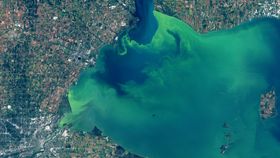


Is Lake Erie glowing a ghostly green in preparation for Halloween? Or perhaps an extreme premature St Patrick's Day prank? Not quite.
These stunning images show the giant North American lake bursting with a vibrant green hue due to a harmful algal bloom.
The satellite images, shown in natural color, were taken on September 26, 2017, by the Operational Land Imager (OLI) onboard the Landsat 8 satellite. There's also some rather beautiful aerial photography of the phenomenon taken by pilots flying above Ohio. This year’s bloom was first reported in July in Maumee Bay, but has since spread eastwards and northwards within the lake’s western basin, along the shore of Michigan, Ohio, and Ontario.
The prime suspect behind the algal bloom is phosphorus draining into the lake from agricultural or industrial sources. This phosphorous makes the algae go into a “feeding" frenzy when it enters the water. This process is known as eutrophication.
The bloom contains Microcystis, a type of freshwater cyanobacteria, according to the National Oceanic and Atmospheric Administration (NOAA). It might look pretty from the skies, but these phytoplankton produce toxins that can contaminate drinking water and pose a risk to human and animal health, including irritation to the skin and respiratory distress. Along with this, the process of eutrophication can leave lakes starved of oxygen (not to mention it can really kick up a stink).
The problem has been documented at Lake Erie before, with reports appearing as far back as the 1960s. This Great Lake was said to be "dying" during the 1960s due to water quality problems, according to the EPA. Although there's been extensive efforts to clean it up, it's still pretty polluted and, evidently, loaded with phosphorus.