


 Nature
 PUBLISHED


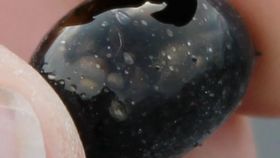


Amid the recent explosive flurries from the Halemaʻumaʻu Crater on Hawaii's Kilauea volcano, researchers have found something very special – a glass-like, black dragon egg.
OK, not quite a dragon’s egg. But the researchers from the Hawaiian Volcano Observatory are nonetheless pretty excited to find this extremely unique-looking Pele’s tear, proclaiming it as the “Coolest Pele's Tear ever!”
This 1.5 centimeter (0.5 inch) treasure was found by Tim Orr near the rim of Halema'uma'u Crater on January 8, 2015, roughly 110 meters (360 feet) above the lava lake from which it is believed to have been spat from.
These glassy deposits are often spewed from volcanos and their lava lakes, but it’s rare to find one in this oval shape. They are formed when molten lava is ejected in a volcanic fountain and then cools extremely quickly. Due to this swift process of formation, they’re more likely to be an irregular shape.
Pele’s tears are steeped in the history and culture of Hawaii. They’re named after Pele – the beautiful, yet temperamental, Hawaiian goddess of volcanoes. Volcanologists, locals, and travelers also regularly come across Pele’s hair. These are a similar phenomenon caused by molten lava cooling rapidly, however, they take on a strand-like appearance, a bit like volcanic fiberglass.
Halema'uma'u Crater has been pretty lively the past few weeks. It is believed to be riled up by a rockfall causing changes to the lava lake’s volatile pressure systems.
“To my knowledge, it’s the only thing like it that has ever formed,” Orr told the Honolulu Star-Advertiser.
“I have nothing else that I can call it,” he added. “I don’t know how it could have formed.”
Check out the footage below of the Halema'uma'u Crater of Kilauea, filmed around the same time the quirky Pele’s tear was formed.



 1
1