Humans
 PUBLISHED


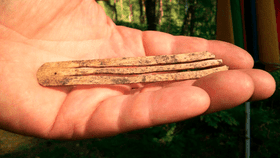


They don’t make stuff like they used to. Archaeologists have recently discovered a 1,700-year-old instrument in the mountains of southern Russia that you can still use to play music.
The instrument, around 11 centimeters ( just over 4 inches) in length, was carved by nomadic Huns around 1,740 to 1,580 years ago in present-day Russia. It was recently discovered at an archaeological site in the Altai Mountains, the mountain range that stretches across Russia, China, Mongolia, and Kazakhstan.
Ancient craftsman created the instrumented by splitting the rib of a cow or horse into two pieces, as reported by the Siberian Times. They would have then fashioned the remains into a three-forked contraption, much like a mouth harp or a “Jew's harp,” where the “handle” is placed into the performer's mouth and the forks are plucked with the finger to create a twanging sound. Since bone is strong yet surprisingly flexible, it’s the ideal material to create such an instrument.
Along with one specimen that was still able to create a tune, archaeologists also discovered a broken mouth harp and three others they believe were in the process of being carved.
“One of the harps is so perfectly preserved that you can play it. But there will be slight sound distortion because a tiny part was damaged,” said Andrey Borodovsky, a professor at the Institute of Archaeology and Ethnography in the Siberian branch of the Russian Academy of Sciences, according to the Mail Online.

The Huns were a nomadic confederation of tribes who lived in the Caucasus of Eastern Europe and Central Asia between the 4th century CE and the 6th century CE. They were not a literate culture and left no written documents, so most of the information we know about them comes from other cultures (who didn’t like them much on the whole). This also means it’s hard to say what kind of melodies would have been played through this bone instrument.
If you’re curious about ancient music, check out this incredible rendition of a 3,400-year-old song taken from a musical notation found on a tablet in modern-day Syria. The oldies are the best, after all.