


 PUBLISHED




The seafloor of the Caribbean Sea looks like a pirate's idea of heaven. Just off the coast of Colombia lies a shipwreck loaded with one of the most valuable hauls of treasure ever lost at sea, estimated to be worth up to $17 billion in today’s money.
The wreck of the San José, often called the “holy grail of shipwrecks”, was first discovered off the coast of Colombia three years ago. However, many details of this intriguing find have only just been released by the authorities.
The Spanish galleon was sunk by a British squadron during the War of the Spanish Succession on June 8, 1708. Loaded with 62 guns and up to 600 crew, this colossal ship sank along with its vast treasure trove of gold, silver, and emeralds. The ship was transporting the riches as part of the Spanish king's mission to loot the South American colonies to fund the costly 13-year-long war. By no surprise, this booty meant that governments, treasure hunters, and researchers had been searching for the wreck for decades, until it was eventually discovered 600 meters (1,968 feet) beneath the waves by the Colombian Navy near Cartagena in 2015.

Over the past few years, the wreckage has since been explored by the Woods Hole Oceanographic Institution (WHOI) using sonar imaging and an autonomous underwater vehicle called REMUS 6000, which has captured numerous new photographs of the site. REMUS was also used to map and photograph the Titanic wreck site during a 2010 expedition and played a key role in the discovery of the wreck of the Air France 447 passenger plane in 2011.
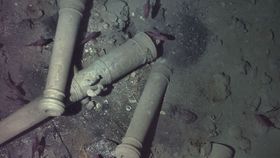
The crystal-clear images captured by the autonomous vehicle show numerous features that haven't been seen by human eyes for over 300 years, such as dozens of smashed teacups (pictured below) and ceramics used by the ship’s crew. One incredibly cool discovery was the stunning engravings of dolphins on the ship’s bronze cannons.
“The wreck was partially sediment-covered, but with the camera images from the lower altitude missions, we were able to see new details in the wreckage and the resolution was good enough to make out the decorative carving on the cannons,” expedition leader Mike Purcell, IWHO engineer, said in a statement.

As for the billions of dollars worth of gold and silver, it remains at the bottom of the sea. Who owns the treasure is the subject of a massive legal dispute, with Colombia and an American salvage company called Sea Search Armada both eager to take a slice of the pie. In the meantime, the philosophy driving this excavation has been “exploration, not extraction”, however, as more and more discoveries are made onboard the shipwreck, the issue of ownership increasingly looms.
In more shipwreck news, an 800-year-old Chinese ship was recently identified thanks to its "Made in China" label – seriously.
